by: Rev. Filibus Bakari Auta
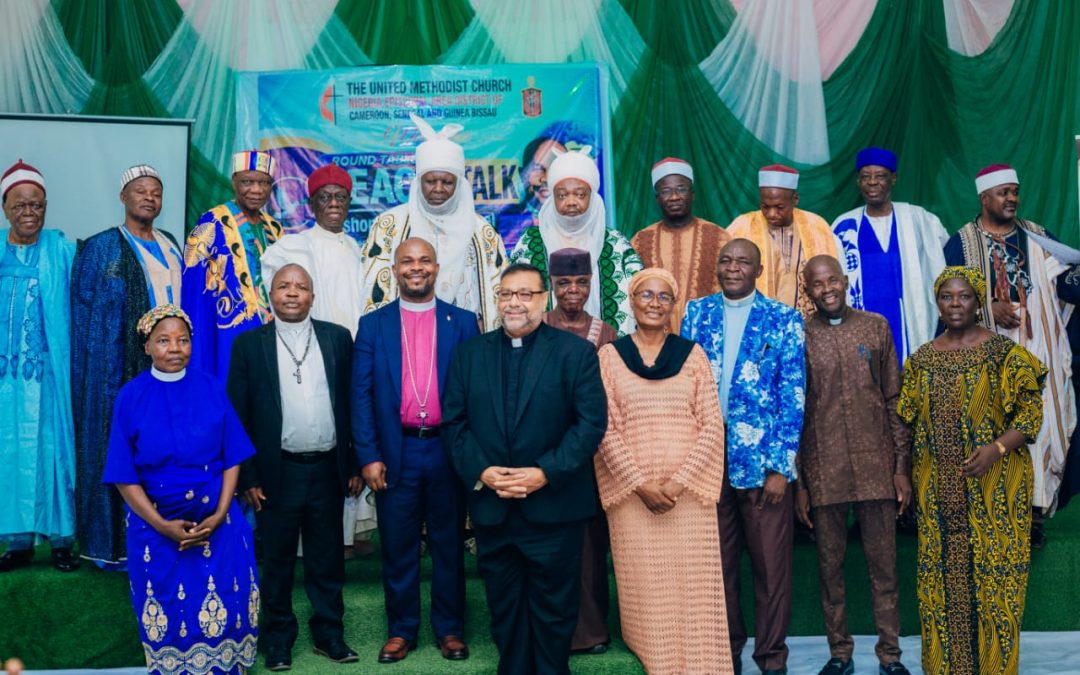
The United Methodist Church Nigeria, Cameroon, Senegal and Guinea-Bissau Episcopal Area has concluded a five-day Strategic Peace and Conflict Transformation Seminar aimed at equipping frontline church and community leaders with practical knowledge and skills to prevent conflict, promote reconciliation and build sustainable peace across Nigeria.
The seminar, held from August 24 to 28, 2026, brought together frontline church and community leaders from the Southern Nigeria and Southwestern Nigeria Annual Conferences, as well as traditional rulers, government officials, media practitioners and representatives of civil society organizations.
The programme, facilitated by Rev. Dr. Neal Christie, former Assistant General Secretary of the General Board of Church and Society and currently Principal of Faith Beyond Religious Nationalism and a consultant with Wespath, focused on conflict prevention, conflict transformation, reconciliation and peacebuilding, with particular emphasis on strengthening collaboration among religious and community leaders.
Neal while commenting after the seminar said: “This is the first of four focused skills based training for first responders. Every first responder will be reporting back on what they see and hear and ways they have intervened to bring about greater peace and conflict transformation. It’s these networks of Peace builders and conflict transformers working across differences that will make the greatest impact in the United Methodist Church across Nigeria.”
Speaking during the Peace Talk and Media Interactive Session, Bishop Ande I. Emmanuel, Resident Bishop of the United Methodist Church Nigeria Episcopal Area, emphasised that sustainable peace cannot be achieved by Christians, Muslims, government, the media or any single institution acting in isolation.
He commended the participation of stakeholders from diverse religious and professional backgrounds, describing the engagement as a demonstration of the importance of interfaith and multi-sector cooperation in building peaceful communities.
“Peace is a shared responsibility. Peace is a human responsibility. Peace is a national responsibility. And for those of us who are people of faith, peace is also a sacred responsibility.”
Bishop Solomon Rubiruka said the seminar was convened because Nigeria, Taraba State, local communities, families, churches and mosques all need peace, adding that the objective was not merely to discuss peace but to challenge participants to identify what they could individually and collectively do to make peace possible.
Bishop Ande acknowledged Islamic teachings that promote peace and peaceful coexistence, referencing Qur’an 8:61 and 49:13. He encouraged Christians and Muslims to see one another as partners in peace and to embrace dialogue, justice, mutual respect and reconciliation rather than violence and revenge.
The Bishop explained that conflict transformation goes beyond simply stopping violence, noting that while conflict management may focus on ending confrontation, conflict transformation seeks to address the underlying conditions that cause conflicts to emerge and recur.
Rev Cetus David Khuturu identified grievances, inequality, mistrust, exclusion, injustice, identity, leadership, relationships, structures and narratives as critical issues that must be addressed in the pursuit of lasting peace.
“Conflict transformation requires more than an agreement. It requires transformed relationships.”
He therefore urged stakeholders to ensure that reconciliation extends beyond formal agreements to individuals, families, congregations and entire communities.
Bishop Emmanuel drew lessons from the United Methodist Church’s own experience of internal conflict involving leadership disputes, damaged relationships, factions, court cases and divisions within congregations and communities.
According to him, the experience has demonstrated the destructive consequences of prolonged conflict while also creating an opportunity for the Church to testify to the power of reconciliation.
He noted that the Church has begun moving from division towards reconciliation, confrontation towards dialogue, fragmentation towards greater unity, and wounded relationships towards healing.
“If a divided church can begin to find its way back to unity, then divided communities can also find their way back to peace.”
He urged the Church to make its experience of reconciliation part of its public witness to Nigerian society.
Bishop Emmanuel challenged media practitioners to recognise their responsibility in shaping public understanding of conflicts, stressing that the media does more than report events; it also influences how society interprets them.
He urged journalists to verify information, investigate claims, cross-check facts, provide context and clearly distinguish facts from allegations.
He cautioned against allowing social media to turn newsrooms into “forwarding centres” and warned journalists against publishing inflammatory content simply because it attracts attention.
The Bishop encouraged journalists to deliberately report stories of reconciliation and cooperation, identify early warning signs, expose injustice before it escalates into violence and provide platforms for communities to express their concerns.
Also speaking at the seminar, Rev. Eli Sule Yakku, Dean of Cabinet for the Nigeria Episcopal Area, called on the Church to embrace peacemaking as a sacred mandate and a central expression of the Gospel of Jesus Christ.
Drawing from Matthew 5:9, “Blessed are the peacemakers,” Yakku said the Church must remain a prophetic voice that speaks truth, promotes justice, heals wounds and builds bridges across social, religious and community divisions.
“Peacemaking is not an option for the Church; it is part of our Christian vocation.”
He urged church leaders to approach conflicts with the wisdom, compassion and courage of Christ rather than retaliation or revenge, encouraging them to listen to people on different sides of conflicts, understand their pain and help create pathways towards reconciliation.
Referencing Romans 12:18, Yakku reminded believers that everyone has a responsibility to pursue peace.
“We cannot wait for others to make the first move. Each of us must become an instrument of peace in our homes, churches, communities and nation.”
He charged participants to return to their respective communities as ambassadors of Christ’s peace, ministers of reconciliation and prophetic witnesses for justice and unity, stressing that the credibility of the Church’s witness will increasingly be measured by its ability to demonstrate the peace it proclaims.
Bishop Emmanuel called on Christian and Muslim leaders to ensure that churches and mosques never become platforms for hatred, while advocating regular Christian-Muslim engagement, interfaith dialogue and joint initiatives involving young people and women.
He cautioned against collective blame based on religious identity, stressing that the actions of extremists must not be attributed to entire religious communities.
Traditional rulers, he said, remain important peacebuilding actors because of their knowledge of local histories, relationships and grievances. He therefore called for stronger partnerships with traditional institutions in early warning, mediation, dialogue, reconciliation and community healing.
Government, according to the Bishop, must strengthen public trust through justice, security, good governance and equal protection under the law.
“Good governance is peacebuilding. Justice is peacebuilding. Development is peacebuilding. Education is peacebuilding. Employment is peacebuilding. Security is peacebuilding.”
He also called for greater inclusion of young people in peacebuilding processes, urging stakeholders to move away from viewing youth merely as a problem and instead empower them through education, skills acquisition, employment, leadership opportunities and meaningful responsibilities.
He noted that young people with hope and opportunities are less vulnerable to recruitment into violence.
Similarly, he advocated greater participation of women in peacebuilding and decision-making, recognising their contributions to mediation, community rebuilding and reconciliation.
Participants commended the seminar for strengthening their capacity to respond more effectively to conflicts within their churches and communities.
Rev. Hanatu Robinson, District Superintendent of Eugene Wesley Southern Nigeria Annual Conference, said the training had equipped her with practical conflict transformation skills that would enhance her ability to respond to conflicts involving church members and pastors in her district.
Similarly, Mr. Joel Gilenya, a Lay Leader from the Southern Nigeria Annual Conference, described peace as essential to meaningful development and urged participants to return to their communities as ambassadors of peace and agents of conflict transformation.
As part of his closing address, Bishop Emmanuel proposed a seven-point peace commitment for participants and other stakeholders:
Seven-Point Commitment for Peace
1. Speak the truth without spreading hatred.
2. Verify information before amplifying it.
3. Choose dialogue before escalation.
4. Protect human dignity.
5. Build bridges across religious, ethnic, political and social divides.
6. Pursue justice without revenge.
7. Make peacebuilding a way of life.
He urged Christians and Muslims to protect the relationships that unite their communities and encouraged Taraba State to demonstrate that religious diversity can become a source of strength rather than conflict.
Addressing members of the United Methodist Church, Bishop Emmanuel also urged the Church not to take its renewed unity for granted, calling on members to place Christ above personalities, mission above ambition, unity above faction and reconciliation above revenge.
“Let Every Nigerian Become a Bridge-Builder”
Concluding the engagement, Bishop Emmanuel called on the Church, mosque, media, traditional institutions, government and civil society organisations to become bridges connecting divided communities.
“Let us go forward together—not as enemies, not as divided communities, but as fellow human beings, fellow citizens, and builders of peace.”
The five-day seminar ended with a renewed call for frontline church and community leaders to translate the knowledge and skills gained into practical actions within their respective communities.
Participants were challenged to move beyond discussing peace to becoming active builders of peace by strengthening dialogue, reconciliation, justice, mutual respect and peaceful coexistence in their churches, communities and across Nigerian society